


For those of you who are entirely on your own like me when running your car....who here uses pressure bleeders and what is your experience like?
I have a dual tube bleed bottle + pressure bleeder and i'm not sure if i'm doing something wrong. My master cylinders are on the RHS (UK) and so I start from the RR and work my way clockwise round to the FR. I open both nipples on each caliper at the same time and using the pressure bleeder, im' finding that i can never seem to get both sides of the caliper showing no air bubbles through the tubes, there always seems to be one side that shows a single small bubble every few seconds and its consistent.
I went round the car twice because the first time round the brakes felt ultra soft so figured i'd done something wrong, pumped the brakes a number of times (holding clutch in), and repeated the bleed procedure again. The pedal does feel better now but I just don't know if it's definitely correct or not. If I stamp on the brake and use all my strength I am reading 40-43 bar at the Front.
Am i doing this right, or is there something inherent with the nipple or caliper design that means I will always see this consistent air bubble appearing as a constant stream on each caliper?
i can't think of a better way to do this on my own.

When you say 'pressure bleeder' you mean a device that's put a controlled air pressure onto the master cylinder and 'pushes' fluid through the system - correct? (rather than a vacuum bleeder that 'pulls' fluid through the bleed nipples)
Assuming that's correct - then I think your issue might be that you are opening both bleed nipples at the same time (and I'm not sure why you would think to do that?). I've never heard of someone bleeding both nipples at the same time - you don't need to and it's just an added complication. Having said that, I'm not sure exactly why that would give you the problem you are seeing either. I assume you know that you must keep the master cylinder well and truly topped up to ensure no air gets in the circuits from that end?
Your process of moving around the calipers sounds OK. But when you get to each one I would bleed the inner nipple first (until no air is present)... then bleed the outer nipple (same).
Try that and see how you go...
I use a vacuum bleeder and do the job on my own. I see air sometimes that's not actually coming from within the brake system - its' being pulled in down the threads in the nipple that's open. To prevent this I only open the nipple enough to get a small amount of flow... that seems to prevent the nipple letting air in for some reason.
Doing it this way I never have any issues.
Bonjour, effectivement, cela peut être compliqué de bien purger ses freins a 100%
Pour une purge, je vous conseille fortement d'installer des purgeurs STAHLBUS. Ils sont vraiment top, et facilitent grandement le boulot en solo 😁
Hello Rod! so i took your advise...
yes correct re: pressure bleeder, attaches to the reservoirs. The reason I was doing both at the same time was because the local team I have used in the past to help prep with the car said they use a dual bleed bottle and bleed with both nipples open whilst pumping the pedal, so i was trying to replicate that (without pumping the pedal).
Anyway this time i've done one nipple at a time (inner then outer) and I believe i've resolved it as i didn't see any continuous air bubbles and made sure the resevoir wasn't draining to very low. There was a lot of air in the system.
I'd say the pedal feels somewhat normal now. A vacuum bleeder might be the way to go as i guess you can then easily top up the reservoirs, whereas with my pressure bleeder it attaches to the reservoir and I have to remove, fill, reattach, repressurize for each caliper.
@rojid .... Hi Again, Glad you has some success. Sounds like you had been drawing air in through the master cylinder given there was so much air in the system. The pressure bleeding system then just pushes any/all fluid through until it runs out and air starts to enter the system.
Vacuum bleeding works fine for me... but if you are too aggressive with opening the bleed nipple (not how fast you open it but how far) then it can cause air to be pulled in down the side of the bleed nipple threads and back up through the nipple into your bleed line. This makes it look like air is coming out of the caliper/system... but it is not. It is simply getting pulled in on the outside of the bleed nipples thread and then immediately getting sucked up through the nipple into the bleed line. Don't be fooled by that (I was until I worked out what was happening... )
The way to prevent this being a problem is to only open the bleed nipple a small amount - just enough to establish a flow from the caliper. For me that's normally about 1/8 of a turn or less.
(Assuming you haven't got air in the system all the way back at the master cylinder) If there is no air getting pulled through after you have drained about 50ml of fluid through each nipple... then there is no air in the system. Lock off the bleed nipple and move to the next one. I bleed the inner nipple on each caliper first. Bleeding 8 nipples with about 50ml each uses around 400ml and brake fluid is normally sold in 500ml lots... so easily enough to bleed the system. I bleed the clutch slave every second time I bleed the brakes and there is still enough to do that as well.
The other good thing about the vacuum bleeder is that if your fussy (I am!) and don't want any brake fluid residue leaking out over your caliper after you've finished.... then once the bleed nipples are locked off you can go back around with the vacuum hose on the bleeder and suck the remnants of brake fluid out of the nipple (in the hole in the top). After I've done that I then use some brake cleaner aerosol to fill it back up and then suck that into the bleeder as well. The nipples are always nice and dry after that.
@rjbender what vacuum bleeder do you use? one that hooks up to an airline or a simple hand pump one? I'm going to get one as it will be a lot easier to keep the reservoir topped up as a I bleed using that instead of a pressure bleeder whereby I have to keep removing it to top up and repressurize. Making the job 4x longer than it ought to be.
@rojid … Hi Mate, See below some pictures of the bleeder (runs by compressed air through a venturi when the trigger is pulled which draws a vacuum), and the bleeder bottle that I use.
Another tip is to use a 15ml or 20ml syringe (I buy them at a local veterinarian practice) to transfer brake fluid out of the container it’s supplied in, down into the crash box where the master cylinders are located…. Much cleaner and you don’t spill a drop.

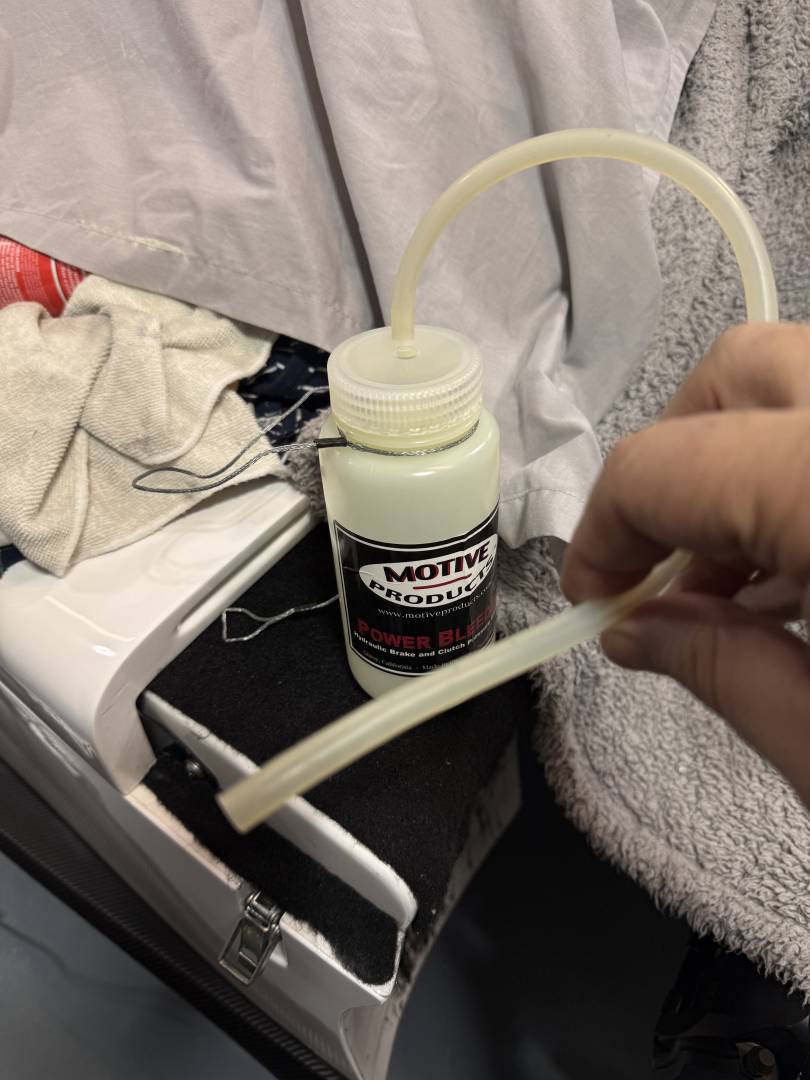
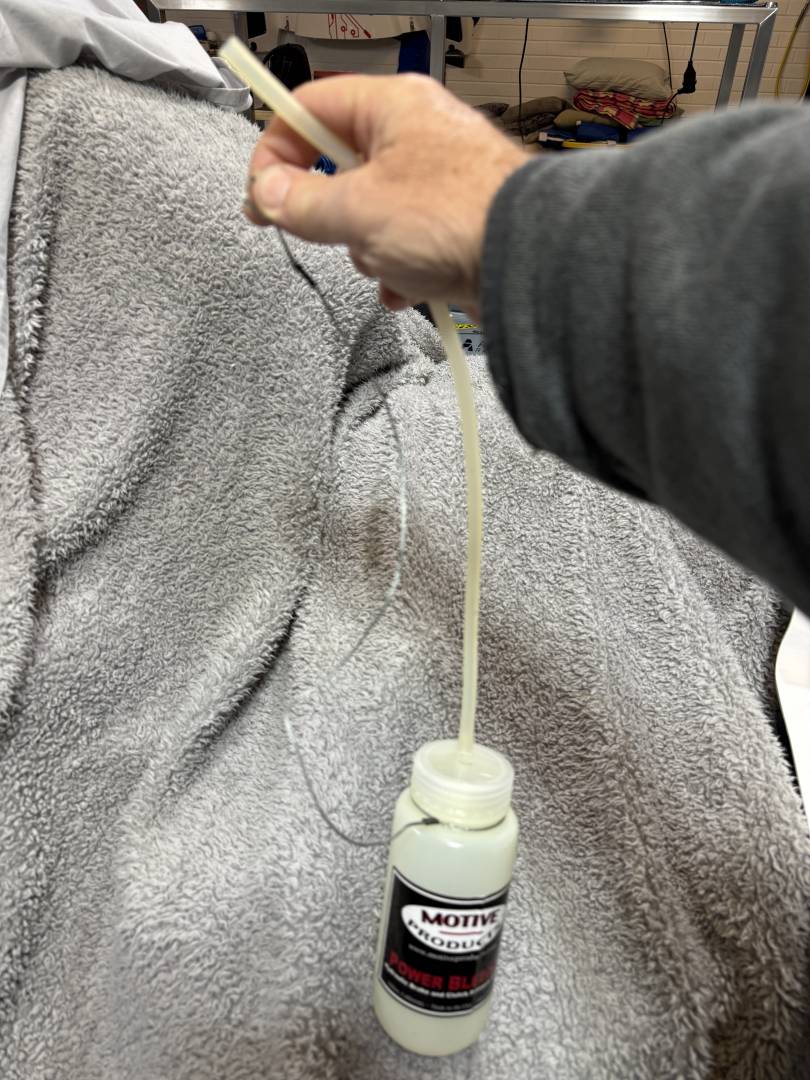
I found the tilton racing bleed guide and it gives a specific procedure which seems quite different to what you do - i'm wondering if it matters or not, given that you're sucking fluid out rather than pushing it through using the pedal, so maybe this procedure only applys to the latter scenario?
if i have to do front and rear axles at the same time then this is trickier to do even with 2 people..the helper would have to quickly open and close the nipples. It does say in the video that you do the inner then outer for calipers with dual bleed screws.
The only way i could think of doing both axles on my own is by getting 2 of those one-way flow tubes connected to 2 bleed bottles.
@rojid … The video relates to a process where your are using someone else to actuate the brake pedal to ‘pressure bleed’ the brakes… nothing like vacuum bleedng I’ve described. I’ve also done this process plenty of times at the track…. And seen other people do it… and have never seen anyone do both front and rear circuits at the same time!… I understand why they might recommend that (to keep the brake balance bar roughly aligned during the bleeding process) but I’ve never had a problem when doing the front and rears separately.
The main risk while doing it this way in a Radical is that you can damage the brake balance cable if you don’t get the person in the car to depress and hold the clutch pedal down the whole time while actuating the brake pedal… it can kink the cable.
I think you are way overthinking this… and don’t think I can offer any more help that I already have. Maybe you just need to find a process that works for you (I think I understood like me that most times you don’t have help in the garage). If you have plenty of help then just bleed them like in the video… up to you.
@rjbender the issue was the brake pressure sensors. I emailed radical tech first and Joshua mentioned it was highly likely to be that so ought to try that first, and he was right. The lines leading to the sensors must have just been full of air.
He also said using a pressure bleeder should be absolutley fine as well. We couldn't access the switch so i'll reposition that in the crashbox to a more convenient spot and bleed that too.
but yes bleeding the sensors immediately gave me back a pedal which became firmer to push with more travel rather than a mushy feel all the way through!